Why We Make Size-Down Adapters (But Not Size-Up Adapters)
We get asked this constantly:
“Why don’t you make an adapter that lets me connect a 1-1/4″ hose to a 2-1/2″ port on my planer or table saw?”
Fair question. Especially since we say we’re building connectors for every hose and every tool port.
This post is the “taps the sign” version so we can point to it the next time the question comes up.
Short answer: because it doesn’t solve the problem people think it solves.
Long answer below.
Airflow Is About Area
Dust collection performance mostly comes down to air volume, measured in CFM (cubic feet per minute).
The blower produces the airflow.
The cross-sectional area of the ducting determines how much air can actually move through the system.
The thing that trips people up is that hose capacity scales by area, not diameter.
A hose that’s twice the diameter does not carry twice the airflow.
It carries four times as much.
That’s because the area of a circle grows with the square of the radius.
Here’s the math:
4″ hose area ≈ 12.6 sq in
2.5″ hose area ≈ 4.9 sq in
1.25″ hose area ≈ 1.2 sq in
So stepping down in hose size reduces potential airflow dramatically:
4″ → 2.5″ = about 60% less area
2.5″ → 1.25″ = about 75% less again
And that matters because of one fundamental rule of airflow systems.
The Smallest Cross Section Wins
In any airflow system, the smallest cross-section anywhere in the path determines the maximum airflow the system can deliver.
That point becomes the highest-resistance section of the system.
You see the exact same physics in other systems:
Water supply lines
Electrical circuits
Ventilation ducting
The narrowest point controls the flow.
If your tool has a 2.5″ port, then the air ultimately has to pass through an opening with about 4.9 square inches of area.
If your hose is 1.25″, the airflow must pass through 1.2 square inches somewhere in the system.
That smaller section becomes the limit.
Why “Sizing Up” Doesn’t Do What People Expect
This is where the confusion usually starts.
Someone has a 1-1/4″ hose and a tool with a 2-1/2″ port. They assume that if they adapt the hose up to the bigger port, the airflow will increase.
It won’t.
The system still contains a 1.25″ section, and that section caps the airflow.
All the air that eventually reaches the tool still has to move through that smaller hose.
So while the adapter might make the connection physically possible, it does not increase the airflow capacity of the system.
At best, it’s no better than running the small hose directly.
Often it’s worse because you’ve added turbulence, dead space, and another potential leak point.
Why Size-Down Adapters Actually Matter
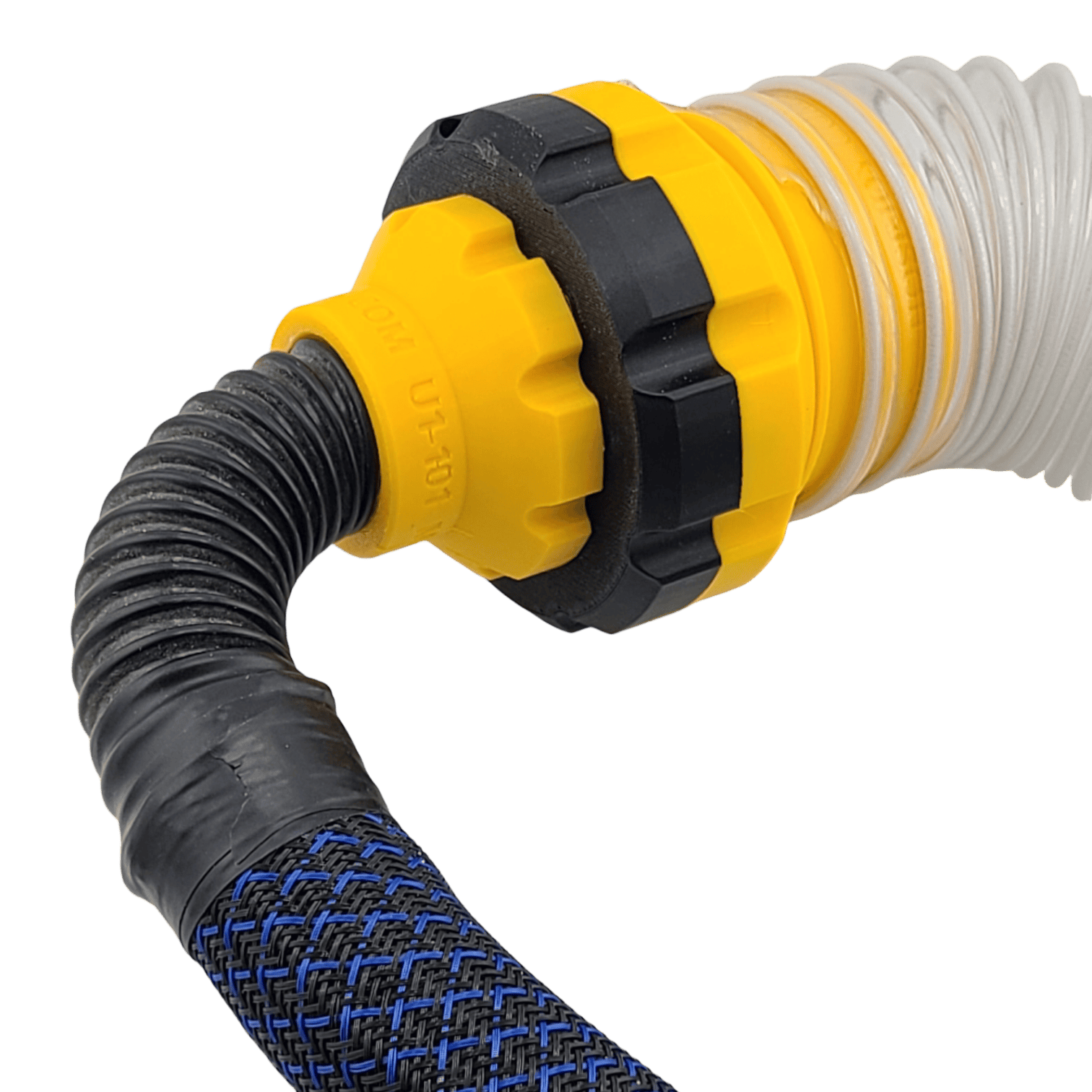
Size-down adapters exist because they solve a real system design problem.
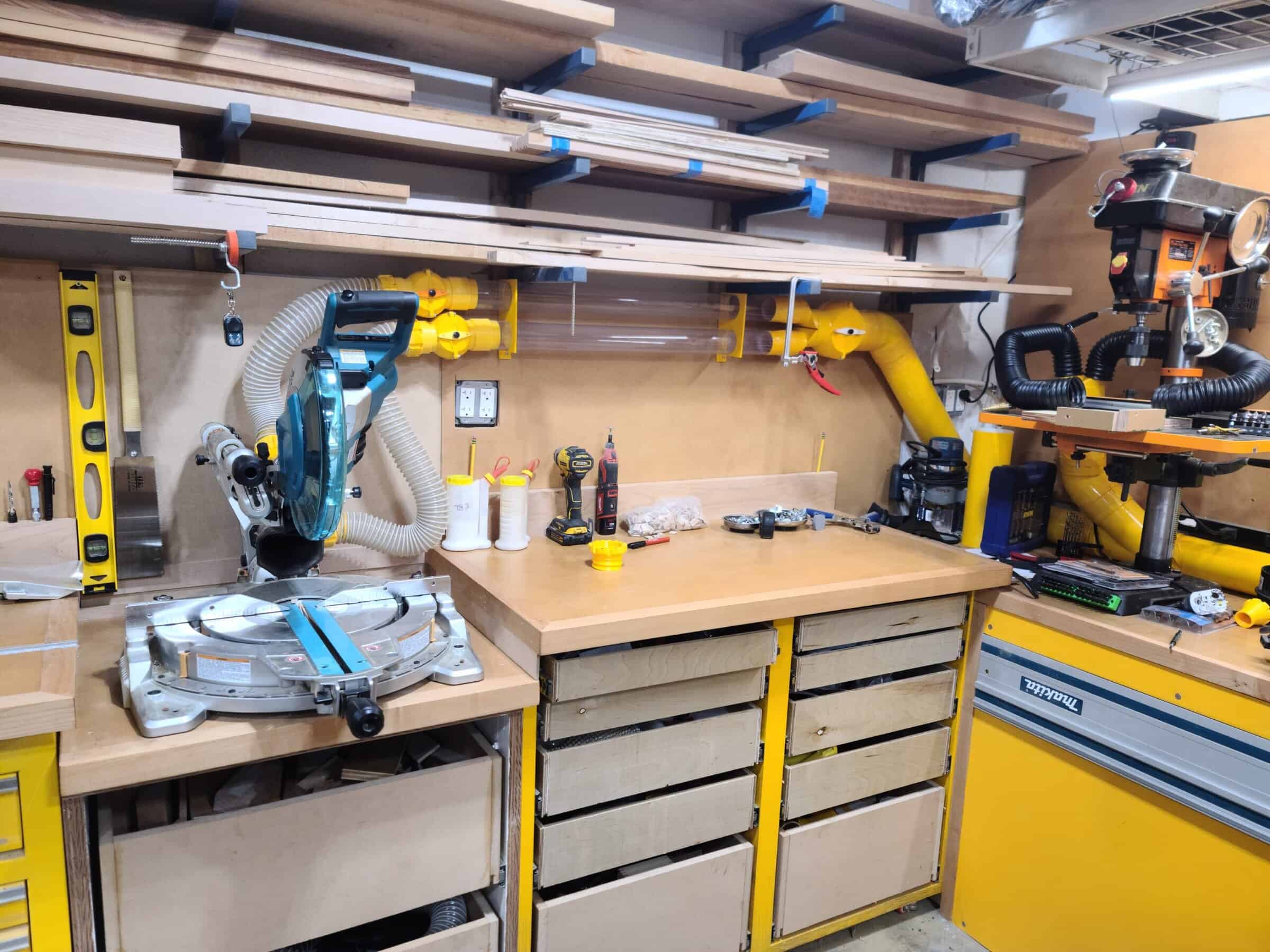
Most dust collection systems start with large ducts — typically 4″ or larger for stationary tools and 35mm or larger for hand tools — so they can move a lot of air efficiently.
But tools frequently have smaller ports.
A size-down adapter lets you:
• run large pipe through most of the system
• minimize friction losses in long runs
• only reduce diameter right at the tool
That keeps the restriction as late as possible in the airflow path, and because of some ‘woo woo’ in the physics, this can actually increase pressure and velocity at the point of restriction, ideally as close to the point that the dust is being created as possible.
In other words, you’re letting the system move the maximum amount of air until the last possible moment.
That’s good system design.
Will We Make You a Size-Up Adapter?
Sure. If you really want one, we can make it. We’ve already made plenty (though we don’t list them for sale — you have to ask).
But I want to be completely clear about something: You shouldn’t expect it to improve dust collection performance.
Our adapters solve fit problems.
They do not solve airflow limitations.
If your system uses a 1-1/4″ hose, the physics of a 1-1/4″ hose will always apply — no matter what adapter is attached at the end.
That said, a little bit of airflow is obviously better than no airflow at all, so if you absolutely don’t have the option to add a larger diameter hose (equal to or greater than your tool’s port), we can make you an adapter that will allow you to get “better than nothing”.
Our Goal
Dust collection fittings aren’t standardized. One manufacturer’s “2-1/2″ port” might actually be 2.35″. Another might be 2.6″.
That’s the problem we’re solving.
Our goal isn’t to create clever workarounds for airflow physics.
Our goal is simple: Connect every hose to every tool with a clean, airtight fit.
And when it comes to airflow, the rules are the same in every case: the smallest cross section in the system determines the system’s airflow capacity.